Go搭建Web服务器的执行过程(二)
Web相关的几个概念:
Request:用户请求的信息,用来解析用户的请求信息,包括post、get、cookie、url等信息Response:服务器需要反馈给客户端的信息Conn:用户的每次请求链接Handler:处理请求和生成返回信息的处理逻辑
用Go实现Web服务的工作模式流程图:
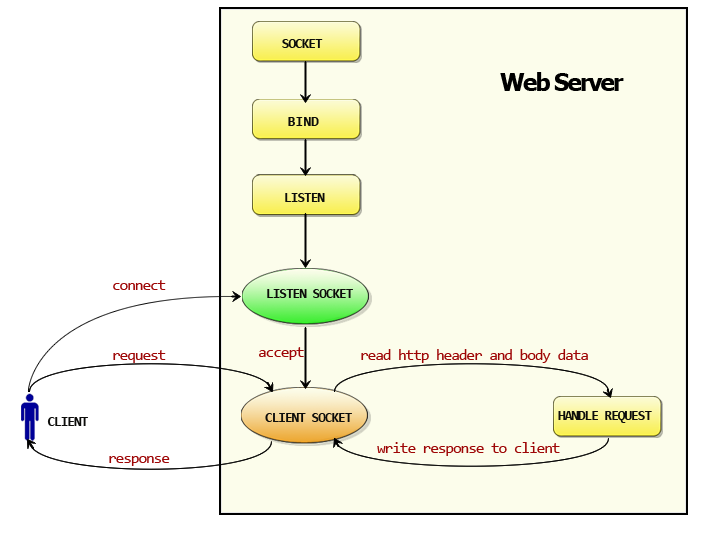
其实主要是三步:
- 创建
Listen Socket, 监听指定的端口, 等待客户端请求到来。 Listen Socket接受客户端的请求,得到Client Socket,接下来通过Client Socket与客户端通信。- 处理客户端的请求,首先从
Client Socket读取HTTP请求的协议头, 如果是POST方法,还可能要读取客户端提交的数据,然后交给相应的handler处理请求,handler处理完毕准备好客户端需要的数据, 通过Client Socket写给客户端。
下面就来分析一下go搭建web是怎么执行的,其实我们把上面的代码如果去掉解析请求参数的部分后,就会很简单:
func main() {
    http.HandleFunc("/", sayHello)
    err := http.ListenAndServe(":9999", nil)
    if err != nil {
        log.Fatalf("ListenAndServe: ", err)
    }
}
func sayHello(writer http.ResponseWriter, request *http.Request) {
    fmt.Fprintf(writer, "Hello World")
}
其实最核心的方法就是http.ListenAndServe(),我们去看一下它的源码:
// ListenAndServe always returns a non-nil error.
func ListenAndServe(addr string, handler Handler) error {
    // 创建一个Server
    server := &Server{Addr: addr, Handler: handler}
    return server.ListenAndServe()
}
上面的Server结构体是什么呢?
// A Server defines parameters for running an HTTP server.
// The zero value for Server is a valid configuration.
type Server struct {
    Addr    string  // TCP address to listen on, ":http" if empty
    Handler Handler // handler to invoke, http.DefaultServeMux if nil

    // TLSConfig optionally provides a TLS configuration for use
    // by ServeTLS and ListenAndServeTLS. Note that this value is
    // cloned by ServeTLS and ListenAndServeTLS, so it's not
    // possible to modify the configuration with methods like
    // tls.Config.SetSessionTicketKeys. To use
    // SetSessionTicketKeys, use Server.Serve with a TLS Listener
    // instead.
    TLSConfig *tls.Config

    ...
}
那server.ListenAndServe()方法是什么呢?
// ListenAndServe listens on the TCP network address srv.Addr and then
// calls Serve to handle requests on incoming connections.
// Accepted connections are configured to enable TCP keep-alives.
// If srv.Addr is blank, ":http" is used.
// ListenAndServe always returns a non-nil error.
func (srv *Server) ListenAndServe() error {
    addr := srv.Addr
    if addr == "" {
        addr = ":http"
    }
    // 监听接口
    ln, err := net.Listen("tcp", addr)
    if err != nil {
        return err
    }
    // 处理接收客户端的请求信息
    return srv.Serve(tcpKeepAliveListener{ln.(*net.TCPListener)})
}
继续看一下Serve方法:
// Serve accepts incoming connections on the Listener l, creating a
// new service goroutine for each. The service goroutines read requests and
// then call srv.Handler to reply to them.
//
// For HTTP/2 support, srv.TLSConfig should be initialized to the
// provided listener's TLS Config before calling Serve. If
// srv.TLSConfig is non-nil and doesn't include the string "h2" in
// Config.NextProtos, HTTP/2 support is not enabled.
//
// Serve always returns a non-nil error. After Shutdown or Close, the
// returned error is ErrServerClosed.
func (srv *Server) Serve(l net.Listener) error {
    // 最后释放资源
    defer l.Close()
    if fn := testHookServerServe; fn != nil {
        fn(srv, l)
    }
    var tempDelay time.Duration // how long to sleep on accept failure

    if err := srv.setupHTTP2_Serve(); err != nil {
        return err
    }

    srv.trackListener(l, true)
    defer srv.trackListener(l, false)

    baseCtx := context.Background() // base is always background, per Issue 16220
    ctx := context.WithValue(baseCtx, ServerContextKey, srv)
    for {
        // 通过Listener接收请求
        rw, e := l.Accept()
        if e != nil {
            select {
            case <-srv.getDoneChan():
                return ErrServerClosed
            default:
            }
            if ne, ok := e.(net.Error); ok && ne.Temporary() {
                if tempDelay == 0 {
                    tempDelay = 5 * time.Millisecond
                } else {
                    tempDelay *= 2
                }
                if max := 1 * time.Second; tempDelay > max {
                    tempDelay = max
                }
                srv.logf("http: Accept error: %v; retrying in %v", e, tempDelay)
                time.Sleep(tempDelay)
                continue
            }
            return e
        }
        tempDelay = 0
        // 创建一个新的Connection
        c := srv.newConn(rw)
        c.setState(c.rwc, StateNew) // before Serve can return
        // 单独开了一个goroutine,把这个请求的数据当做参数扔给这个conn去服务,这就实现了高并发,用户的每一次请求都是在一个新的goroutine去服务,相互不影响。
        go c.serve(ctx)
    }
}
里面会对每次请求都通过一个单独的goroutine去执行c.serve()方法,server()方法内容太多,有点看不明白,这里只贴核心部分:
// Serve a new connection.
func (c *conn) serve(ctx context.Context) {
    c.remoteAddr = c.rwc.RemoteAddr().String()
    ctx = context.WithValue(ctx, LocalAddrContextKey, c.rwc.LocalAddr())
    // 此处省略n行
    ..........
    // HTTP/1.x from here on.

    ctx, cancelCtx := context.WithCancel(ctx)
    c.cancelCtx = cancelCtx
    defer cancelCtx()

    c.r = &connReader{conn: c}
    c.bufr = newBufioReader(c.r)
    c.bufw = newBufioWriterSize(checkConnErrorWriter{c}, 4<<10)

    for {
        // 解析request请求
        w, err := c.readRequest(ctx)
        if c.r.remain != c.server.initialReadLimitSize() {
            // If we read any bytes off the wire, we're active.
            c.setState(c.rwc, StateActive)
        }
        if err != nil {
            const errorHeaders = "\r\nContent-Type: text/plain; charset=utf-8\r\nConnection: close\r\n\r\n"

            if err == errTooLarge {
                // Their HTTP client may or may not be
                // able to read this if we're
                // responding to them and hanging up
                // while they're still writing their
                // request. Undefined behavior.
                const publicErr = "431 Request Header Fields Too Large"
                fmt.Fprintf(c.rwc, "HTTP/1.1 "+publicErr+errorHeaders+publicErr)
                c.closeWriteAndWait()
                return
            }
            if isCommonNetReadError(err) {
                return // don't reply
            }

            publicErr := "400 Bad Request"
            if v, ok := err.(badRequestError); ok {
                publicErr = publicErr + ": " + string(v)
            }

            fmt.Fprintf(c.rwc, "HTTP/1.1 "+publicErr+errorHeaders+publicErr)
            return
        }

        // Expect 100 Continue support
        req := w.req
        if req.expectsContinue() {
            if req.ProtoAtLeast(1, 1) && req.ContentLength != 0 {
                // Wrap the Body reader with one that replies on the connection
                req.Body = &expectContinueReader{readCloser: req.Body, resp: w}
            }
        } else if req.Header.get("Expect") != "" {
            w.sendExpectationFailed()
            return
        }

        c.curReq.Store(w)

        if requestBodyRemains(req.Body) {
            registerOnHitEOF(req.Body, w.conn.r.startBackgroundRead)
        } else {
            if w.conn.bufr.Buffered() > 0 {
                w.conn.r.closeNotifyFromPipelinedRequest()
            }
            w.conn.r.startBackgroundRead()
        }

        // 下面这部分注释说的很明白了
        // HTTP cannot have multiple simultaneous active requests.[*]
        // Until the server replies to this request, it can't read another,
        // so we might as well run the handler in this goroutine.
        // [*] Not strictly true: HTTP pipelining. We could let them all process
        // in parallel even if their responses need to be serialized.
        // But we're not going to implement HTTP pipelining because it
        // was never deployed in the wild and the answer is HTTP/2.
        serverHandler{c.server}.ServeHTTP(w, w.req)
        w.cancelCtx()
        if c.hijacked() {
            return
        }
        w.finishRequest()
        if !w.shouldReuseConnection() {
            if w.requestBodyLimitHit || w.closedRequestBodyEarly() {
                c.closeWriteAndWait()
            }
            return
        }
        c.setState(c.rwc, StateIdle)
        c.curReq.Store((*response)(nil))

        if !w.conn.server.doKeepAlives() {
            // We're in shutdown mode. We might've replied
            // to the user without "Connection: close" and
            // they might think they can send another
            // request, but such is life with HTTP/1.1.
            return
        }

        if d := c.server.idleTimeout(); d != 0 {
            c.rwc.SetReadDeadline(time.Now().Add(d))
            if _, err := c.bufr.Peek(4); err != nil {
                return
            }
        }
        c.rwc.SetReadDeadline(time.Time{})
    }
}
这代代码有点多,其实主要的就是两点:
// 解析request请求
w, err := c.readRequest(ctx)
// 执行server handler的ServeHttp方法
serverHandler{c.server}.ServeHTTP(w, w.req)
这个serverHandler是啥?
// serverHandler delegates to either the server's Handler or
// DefaultServeMux and also handles "OPTIONS *" requests.
type serverHandler struct {
    srv *Server
}
就是说可以是server设置的handler或者是DefaultServeMux,而server的handler是在哪里设置的呢?也就是我们刚才在调用函数ListenAndServe时候的第二个参数,我们前面例子传递的是nil。
那继续往下看ServeHTTP方法:
func (sh serverHandler) ServeHTTP(rw ResponseWriter, req *Request) {
    handler := sh.srv.Handler
    if handler == nil {
        handler = DefaultServeMux
    }
    if req.RequestURI == "*" && req.Method == "OPTIONS" {
        handler = globalOptionsHandler{}
    }
    handler.ServeHTTP(rw, req)
}
因为我们哪里server.handler是nil所以这里就会用默认的DefaultServeMux。
我们继续看一下ServeHTTP函数,它是Handler接口的函数:
// A Handler responds to an HTTP request.
//
// ServeHTTP should write reply headers and data to the ResponseWriter
// and then return. Returning signals that the request is finished; it
// is not valid to use the ResponseWriter or read from the
// Request.Body after or concurrently with the completion of the
// ServeHTTP call.
//
// Depending on the HTTP client software, HTTP protocol version, and
// any intermediaries between the client and the Go server, it may not
// be possible to read from the Request.Body after writing to the
// ResponseWriter. Cautious handlers should read the Request.Body
// first, and then reply.
//
// Except for reading the body, handlers should not modify the
// provided Request.
//
// If ServeHTTP panics, the server (the caller of ServeHTTP) assumes
// that the effect of the panic was isolated to the active request.
// It recovers the panic, logs a stack trace to the server error log,
// and either closes the network connection or sends an HTTP/2
// RST_STREAM, depending on the HTTP protocol. To abort a handler so
// the client sees an interrupted response but the server doesn't log
// an error, panic with the value ErrAbortHandler.
type Handler interface {
    ServeHTTP(ResponseWriter, *Request)
}
这里的实现类是ServeMux,我们看一下ServeMux实现的ServeHTTP的源码:
// ServeHTTP dispatches the request to the handler whose
// pattern most closely matches the request URL.
func (mux *ServeMux) ServeHTTP(w ResponseWriter, r *Request) {
    if r.RequestURI == "*" {
        if r.ProtoAtLeast(1, 1) {
            w.Header().Set("Connection", "close")
        }
        w.WriteHeader(StatusBadRequest)
        return
    }
    h, _ := mux.Handler(r)
    h.ServeHTTP(w, r)
}
上面会根据request选择handler,并且进入到这个handler的ServeHTTP。
// handler is the main implementation of Handler.
// The path is known to be in canonical form, except for CONNECT methods.
func (mux *ServeMux) handler(host, path string) (h Handler, pattern string) {
    mux.mu.RLock()
    defer mux.mu.RUnlock()

    // Host-specific pattern takes precedence over generic ones
    if mux.hosts {
        h, pattern = mux.match(host + path)
    }
    if h == nil {
        h, pattern = mux.match(path)
    }
    if h == nil {
        h, pattern = NotFoundHandler(), ""
    }
    return
}
原来他是根据用户请求的URL和路由器里面存储的map去匹配的,当匹配到之后返回存储的handler,调用这个handler的ServeHTTP接口就可以执行到相应的函数了。
那这里我们再哪里设置了handler呢?
func main() {
    http.HandleFunc("/", sayHello)
    err := http.ListenAndServe(":9999", nil)
    if err != nil {
        log.Fatalf("ListenAndServe: ", err)
    }
}
func sayHello(writer http.ResponseWriter, request *http.Request) {
    fmt.Fprintf(writer, "Hello World")
}
这就要从http.HandleFunc()说起:
// HandleFunc registers the handler function for the given pattern
// in the DefaultServeMux.
// The documentation for ServeMux explains how patterns are matched.
func HandleFunc(pattern string, handler func(ResponseWriter, *Request)) {
    DefaultServeMux.HandleFunc(pattern, handler)
}
然后:
// HandleFunc registers the handler function for the given pattern.
func (mux *ServeMux) HandleFunc(pattern string, handler func(ResponseWriter, *Request)) {
    // 路由器去分发
    mux.Handle(pattern, HandlerFunc(handler))
}
而mux.Handle的实现:
// Handle registers the handler for the given pattern.
// If a handler already exists for pattern, Handle panics.
func (mux *ServeMux) Handle(pattern string, handler Handler) {
    mux.mu.Lock()
    defer mux.mu.Unlock()

    if pattern == "" {
        panic("http: invalid pattern")
    }
    if handler == nil {
        panic("http: nil handler")
    }
    if _, exist := mux.m[pattern]; exist {
        panic("http: multiple registrations for " + pattern)
    }

    if mux.m == nil {
        mux.m = make(map[string]muxEntry)
    }
    mux.m[pattern] = muxEntry{h: handler, pattern: pattern}

    if pattern[0] != '/' {
        mux.hosts = true
    }
}
路由器是怎么分发的呢?它是根据用户请求的URL和路由器里面存储的map去匹配的,当匹配到之后返回存储的handler,调用这个handler的ServeHTTP接口就可以执行到相应的函数了。
那上面的例子中,我们的HandlerFunc是什么呢?她的ServeHTTP呢?
// The HandlerFunc type is an adapter to allow the use of
// ordinary functions as HTTP handlers. If f is a function
// with the appropriate signature, HandlerFunc(f) is a
// Handler that calls f.
type HandlerFunc func(ResponseWriter, *Request)

// ServeHTTP calls f(w, r).
func (f HandlerFunc) ServeHTTP(w ResponseWriter, r *Request) {
    f(w, r)
}
看到了吗?HandlerFunc实现了ServeHTTP接口。
我们调用的代码里面第一句不是调用了http.HandleFunc("/", sayHello)嘛。这个作用就是注册了请求/的路由规则,当请求uri为"/",路由就会转到函数sayHello,DefaultServeMux会调用ServeHTTP方法,这个方法内部其实就是调用sayHello本身,最后通过写入response的信息反馈到客户端。
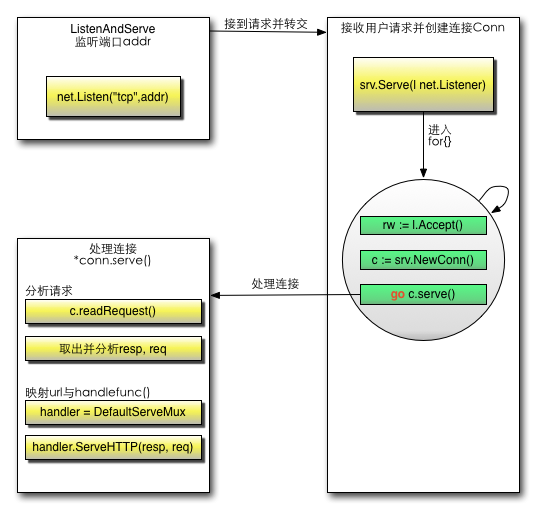
最后总结一下Go代码的执行流程:
-
首先调用
Http.HandleFunc()- 调用了
DefaultServeMux的HandleFunc() - 调用了
DefaultServeMux的Handle() - 往
DefaultServeMux的map[string]muxEntry中增加对应的handler和路由规则
- 调用了
-
其次调用
http.ListenAndServe(":9999", nil)- 实例化
Server - 调用
Server的ListenAndServe() - 调用
net.Listen("tcp", addr)监听端口 - 启动一个
for循环,在循环体中Accept请求 - 对每个请求实例化一个
Conn,并且开启一个goroutine为这个请求进行服务go c.serve() - 读取每个请求的内容
w, err := c.readRequest() - 判断
handler是否为空,如果没有设置handler就设置为DefaultServeMux - 调用
handler的ServeHttp - 在这个例子中,下面就进入到
DefaultServeMux.ServeHttp() -
根据
request选择handler,并且进入到这个handler的ServeHTTP,也就是mux.handler(r).ServeHTTP(w, r)- 选择handler:- 判断是否有路由能满足这个
request(循环遍历ServeMux的muxEntry) - 如果有路由满足,调用这个路由
handler的ServeHTTP如果没有路由满足,调用NotFoundHandler的ServeHTTP
- 判断是否有路由能满足这个
- 实例化
- 邮箱 :charon.chui@gmail.com
- Good Luck!